

















 Team
Team FAQ
FAQ Prices
 Vacancies
 Contact
 Marketing
 SEO
SEO SEA
SEA Strategy
 Sales
Sales Optimization
 AWR
AWR Ahrefs
 Channable
 ContentKing
 Leadinfo
 Optmyzr
 Qooqie
 Hubspot
 Semrush
Written by Niek van Son MSc on May 5, 2023

Introduction
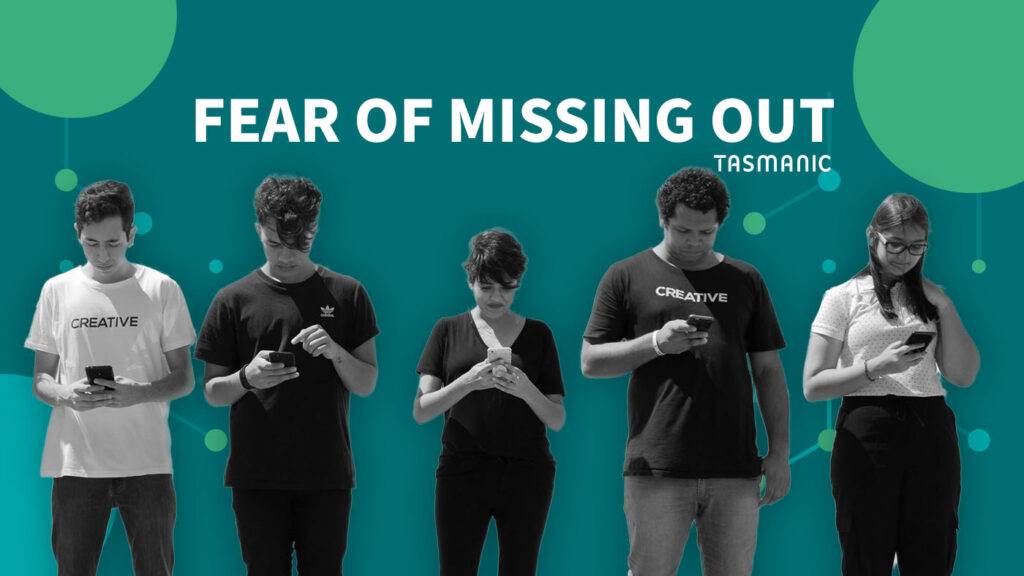
Your friends are throwing a party! You look at your calendar and see that you already have another party that night. An unpleasant feeling creeps up on you. What if this party turns out to be more fun than the one you already had scheduled? Or if something happens that you would have liked to have attended? We call this feeling FOMO: the fear of missing out on things. A phenomenon that many a marketer uses to his or her advantage. As an entrepreneur, how do you capitalize on this to your advantage?
What does FOMO mean?
FOMO is short for Fear Of Missing Out, a term introduced by Patrick J. McGinnis (McGinnis, 2004). It is the fear of missing out on a fun situation or important information by not being there. If you are not present, you cannot be part of the experience that might make your life better. Moreover, you cannot catch up or make up for it afterwards.
This can lead to feelings such as anxiety, sadness, anger or feeling left out. The meaning of FOMO was described by Dan Herman back in 1996 (Herman, 2000).
FOMO is a topic that has been researched more frequently by psychologists in recent years and has only gained a name since today's experience society. FOMO is often thought to be a typical millennial problem, but it is not. The feeling that no matter how good you have it, there is always someone better off is of all ages (Barry & Wong, 2020). However, the Internet and social media have increased FOMO. You used to know no more than what people in your immediate circle had or what you read in the newspaper. Now you see what people in all corners of the world have and can do. That's why the FOMO meaning is more and more familiar.
Real-life examples where you may suffer from FOMO:
- You've just watched an interesting webinar. At the end, a "unique" promotional price comes into view. If you decide to buy the full course within 24 hours, you will benefit from a special price.
- The first 250 people who buy tickets to the event will receive a fun goodie bag with it.
- At a meet & greet, there is only room for 50 people.
- All your colleagues can be at the free mibo this Friday, and it promises to be a fun time. You have a sports club dinner that starts early.
- If you manage to be at the tour on Wednesday afternoon, you will get a unique look behind the scenes. You'll have to reschedule some earlier appointments for that.
- You constantly feel like you have to scroll through your Facebook or Instagram timeline to avoid missing important posts.
- All your friends have purchased the latest iPhone, now you can't be left behind, right?
How does FOMO arise?
Social media play an increasing role in our daily lives. FOMO is more often linked to obsessive behavior related to social media and Internet use (Fioravanti et al.,2021). For example, you see the latest gadgets passing by influencers on social media and then you want them. But on social media, the grass always seems greener next door because often only the best moments are posted: from a happy meal to a gazillion followers. This creates an unrealistic picture of reality.
People who frequently experience FOMO are also called maximizers: people who want to get everything out of life (Schwartz, 2004). People who have less self-confidence, are less satisfied with their lives or seek greater autonomy are more likely to experience FOMO (Przybylski et al, 2013). FOMO is also a form of choice stress (Schwartz, 2004). The fear of making the wrong choice becomes greater because in today's age there are more and more choices and you do not want to regret making the wrong choice. FOMO is therefore a form of loss aversion.
How can you take advantage of FOMO?
As a business owner, you can fuel the feeling of FOMO through marketing to drive demand for a particular product or service. Some ways of FOMO advertising:
- Regularly post images on social media of people overtly enjoying a product.
- Use a well-known popular person to promote a product or service. That's the kind of role model you want to follow!
- Let an attractive promotion be valid only for a limited time. If you don't take action now, you will miss out on the offer!
- When purchasing a product, offer an extension at a more competitive price. For example, buy an admission ticket for today or purchase an annual subscription right away for only a relatively small amount more than the cost of a ticket.
- In an online store, mention how many people are currently looking at the product or how many are still in stock. Don't be late!
- Use pop-ups or notifications to give users the idea that something is happening that they want to be a part of.
- Announce an event well in advance and count down to that moment: this is what you want to be at!
- Create live content that can only be viewed at that time. This ensures exclusivity.
- Regularly deploy ephemeral content (stories): "snack content" that only remains available for 24 hours.
Resources
Barry, C. T. & Wong, M. Y. (2020). "Fear of missing out (FoMO): A generational phenomenon or an individual difference?" Journal of Social and Personal Relationships.
Fioravanti, G., Casale, S., Bocci Benucci, S., Prostamo, A., Falone, A., Ricca, V. & Rotella, F. (2021). "Fear of missing out and social networking sites use and abuse: A meta-analysis" Computers in Human Behavior.
Herman, Dan (2000-05-01). "Introducing short-term brands: a new branding tool for a new customer reality". Journal of Brand Management.
Przybylski, A. K., Murayama, K., DeHaan, C. R., & Gladwell, V. (2013). "Motivational, emotional, and behavioral correlates of fear of missing out". Computers in Human Behavior.
Schwartz, Barry (2004). "5". The Paradox of Choice. New York, United States: Harper Perennial.
"Social Theory at HBS: McGinnis' Two FOs" The Harbus. May 10, 2004
THE AUTHOR
Niek van Son MSc
Marketing Management (MSc, University of Tilburg). 10+ years of experience as an online marketing consultant (SEO - SEA). Occasionally writes articles for Frankwatching, Marketingfacts and B2bmarketeers.nl.
Curious about your company's growth potential?
Take the first step toward above-average growth today. Find out how we lead companies to more than 20% growth.