

















 Team
Team FAQ
FAQ Vacancies
 Contact
 Marketing
 SEO
SEO SEA
SEA Strategy
 Sales
Sales Optimization
 AWR
AWR Ahrefs
 Channable
 ContentKing
 Leadinfo
 Optmyzr
 Qooqie
 Hubspot
 Semrush

Written by Niek van Son MSc on September 2, 2021

Last updated February 29, 2024
What is b2b?
B2b is an abbreviation from economics that stands for business to business. According to Wright (2004), the b2b market operates at both national and global levels. According to Wright, the b2b is best described as a market where a company sells products and services to other companies, which it then buys for its own use or resale.
What is b2b marketing?
Whereas b2b (business-to-business) companies target the business market, b2c (business-to-consumer) companies sell products or services to consumers. With b2b marketing, the target audience needs to be approached in a different way than with b2c, which requires a targeted b2b marketing approach. Online marketing is used for both, although there are still many opportunities within online marketing for b2b companies.
What is a b2b marketing strategy?
To reach companies in the business market, a b2b marketing strategy will need to be chosen. With the right strategy, a company will sell its products and/or services to other companies. A b2b marketing strategy usually targets a smaller customer base compared to b2c. This leaves room for more specialization in the marketing strategy and allows you to build good long-term relationships with customers.
The main differences between b2b and b2c marketing
There are many similarities between b2b and b2c marketing. However, there are some things in which they differ greatly, calling for a different approach.
- B2b marketing often focuses on the decision maker and not directly on the end user. This means that there are multiple stakeholders in purchasing a product or service.
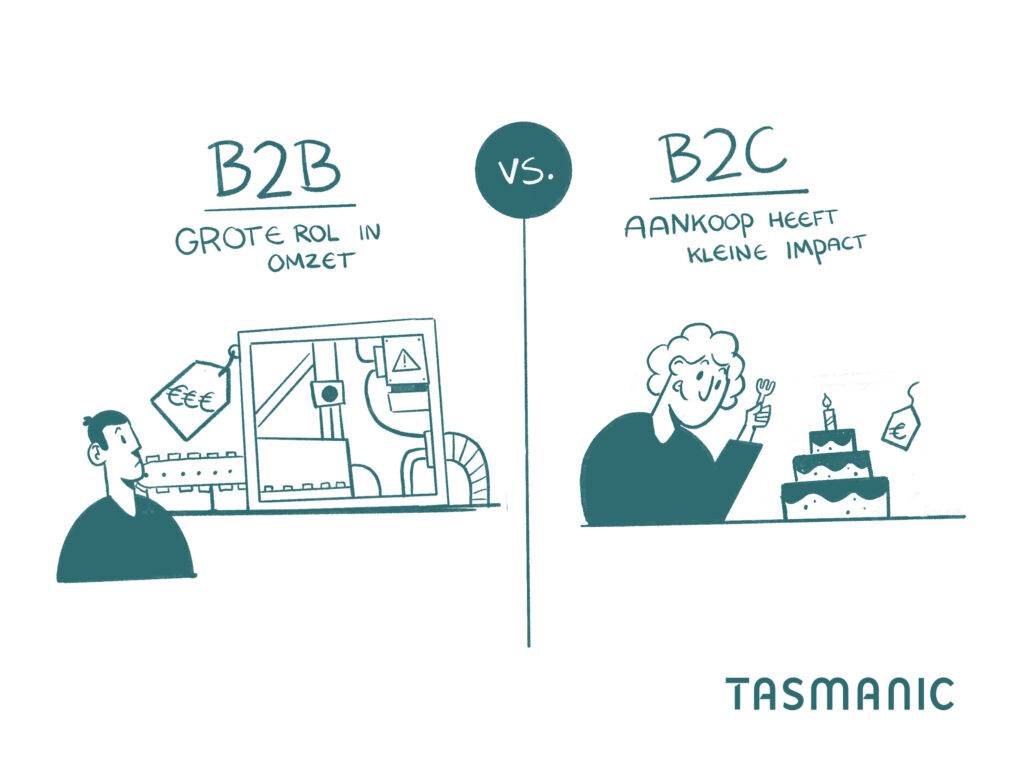
- Purchasing the right b2b products or services often plays a crucial role for companies. Consider here, for example, a machine that the company needs to purchase for carrying out its production. This purchase plays a major role on the company's sales and profitability.
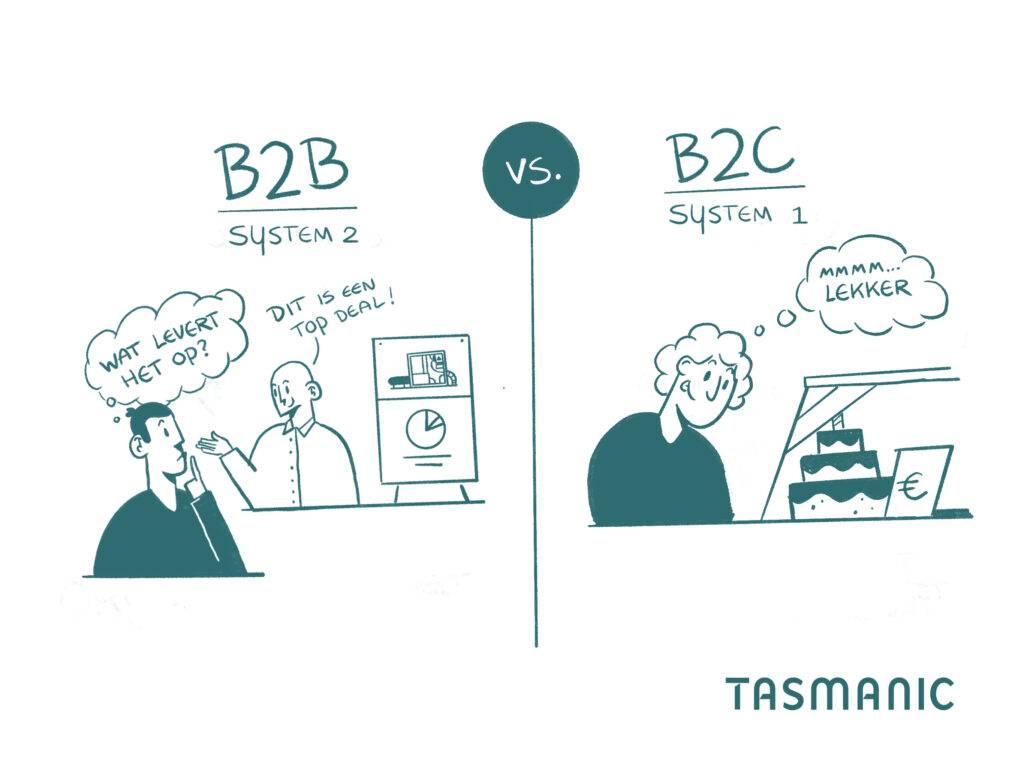
- In b2b we often use system 2, this is slower and takes more effort, but helps us make more difficult choices. Consumers more often use system 1 (especially with products that are bought regularly or are low priced), this is a process that happens automatically, often by feel. It takes us little effort when making choices with system 1.
- The research by Rėklaitis & Pilelienė (2019) also reveals some important differences between b2b and b2c marketing. It shows that in the sales process in b2b marketing there are more constraints compared to b2c, which makes less room for creativity. This is mainly due to the rationality involved in b2b, where in b2c, on the contrary, emotion and human factors play the main role, which gives the marketer more creativity.
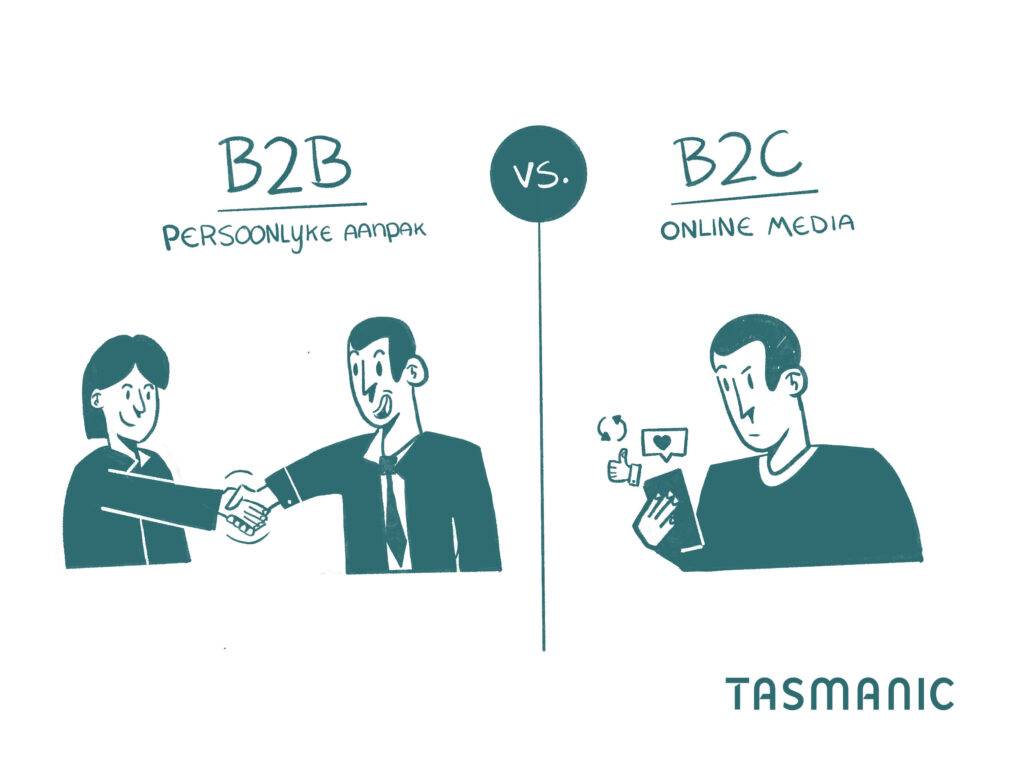
- In addition, we also see in the research that choosing the right media channels is important. The research shows that online media is becoming more important for both forms, but where social media is a must for b2c, that is still not the case for b2b.
- Finally, Rėklaitis & Pilelienė conclude that in b2b marketing, personal communication is the most important form of marketing. When looking at b2c,it is often not even considered as an option.
Examples of b2b companies
A concept like b2b becomes clearer through a number of practical examples.
The most famous example of a b2b company in the Netherlands is the Makro. You cannot go to this wholesaler of food and other products for your groceries as an ordinary consumer. It is a store where, for example, restaurants buy their ingredients in large volumes. So a company buys here products it needs to serve its own customers again.
Another example is a car manufacturer. It does not sell cars to consumers, but to garages who then sell them back to individuals. The manufacturer itself also uses the B2B market. All the different parts come from other manufacturers, creating a whole b2b network.
B2b target audience
The target audience of b2b companies differs greatly from that of b2c companies. The target audience in b2b marketing tends to be the decision maker(s) and not just the end user. It often involves a product or service which is seen as an investment and is relatively expensive. There are multiple stakeholders in the purchase, which makes the decision process longer. The decision to purchase or collaborate is therefore rational and less emotional. For b2b marketers, it is very important to outline an accurate customer profile in order to properly address the needs and considerations of the company and the decision maker. Reliability, professionalism, knowledge and the solution orientation of b2b companies are very important for the business decision maker.
Traditional b2b marketing vs b2b online marketing
Traditionally, b2b companies make extensive use of trade shows and events to connect with potential buyers. PR and direct marketing are also used to approach customers. However, online marketing is becoming increasingly important for b2b companies. And not without reason. There are a number of important objectives that can be achieved with online marketing that directly or indirectly contribute to higher sales in the short and long term.
The importance of online marketing
Miller (2012) emphasizes the importance of online marketing for b2b companies. When competitors use online marketing, they have an advantage over other companies. The competitor can then not only target their current customers more efficiently, but also increase their reach to customers who would not have been initially targeted (new customers). In addition, the study reveals that more and more companies are going online in search of products. As much as 71% of b2b purchases begin on the Web.
Goals of b2b marketing
Whereas a consumer would buy many products online as easily as in a regular store, it often works differently for business decision makers. It takes more to bind a business customer to you. B2b therefore has the following objectives, among others, which precede this ultimate goal.
Lead Generation
Generating contact details of potential customers, after which they can be targeted. More about lead generation >
Customer profiles
Properly identifying the needs of the customer, in order to then be able to optimally respond to these needs.
Lead nurturing
Warm up and keep leads, by converting them step by step - with qualifications, personalized landing pages, contact moments, among other things - into a paying customer.
B2b online marketing tools
There are several b2b marketing tools that are used to achieve marketing objectives. Of which the following are gaining popularity among b2b marketers:
Inbound marketing & content marketing
With inbound marketing, you make customers want to be connected to you as a business. You are a trusted and professional party and you share content and information that is of real value to businesses. This is usually done with interesting blogs, articles, e-books, relevant landing pages with interesting offers and helpful or informative tools. These tools are used to generate leads. These leads are then gradually converted to paying customers with lead nurturing.
E-commerce is no longer secondary
The position of e-commerce in the b2b market has changed significantly in recent years, partly due to the corona crisis. 65% of b2b companies worldwide now offer e-commerce opportunities. That's a 53% increase since the beginning of 2021. Buying products or services online is no longer secondary to selling in person. According to Bangia, Harrison, Plotkin & Piwonski (2022), two-thirds of business customers consciously choose digital or in-person remote interaction. They do so throughout the b2b customer journey, from initial inquiry to reordering. The purchase process is simplified, products are easier to compare and the customer can be targeted for repeat purchases. Additional services or self-service, such as uploading a design for a business card, speed up the purchase process and usually reduce costs. E-commerce offers ample opportunities to improve the customer experience and maximize customer retention.
Marketing automation & interfacing with CRM systems
With marketing automation, various marketing processes are automated. This makes marketing even more effective and a lot more profitable. How do you get leads and how do you ensure that these leads become and stay paying customers? Basically, marketing automation is automating the lead nurturing and customer retention process. By using technology, automation software and analyzing data as much as possible, marketing activities are used effectively and efficiently. With the goal of turning a lead into a new customer and a customer into a loyal customer. Marketing automation includes automatic and personalized mailing lists based on customer profiles and linking marketing activities to a CRM system.
SEO & SEA
SEO(search engine optimization) and SEA(search engine advertising) are also used in b2b marketing to become more findable. However, what is behind the search result or advertisement is even more important in b2b. Whereas a consumer can be persuaded to buy immediately after landing on an attractive landing page, a business prospect needs more. When a b2b business is found, it is important that the content flawlessly matches the searcher's query. The content should be of great value, forming the starting point of the potential customer journey.
B2b products and services
B2b businesses can offer a variety of products and services. They may be business services, such as the services of accountants, marketing agencies and website developers. Office supplies, cleaning supplies, raw materials or retail products. B2b businesses offer other businesses services and products that help them keep their business running and increase sales and profitability.
B2b companies target the business market; other companies. They provide services or products that allow companies to reduce costs or increase sales. The b2b products or services affect a company's profitability. Usually the decision maker is not - or not the only - end user. There are more interested parties in the purchase. This makes the decision process a lot more rational and less emotional. The buying process is relatively long with b2b services and products. Online marketing offers more and more opportunities for b2b companies to distinguish themselves, gain trust and retain (loyal) customers.
Resources
Bangia, M., Harrison, L., Plotkin, L.P. & Piwonski, K. (2022, January 26). Busting the five biggest B2B e-commerce myths. McKinsey & Company. https://www.mckinsey.com/capabilities/growth-marketing-and-sales/our-insights/busting-the-five-biggest-b2b-e-commerce-myths
Miller, M. (2012). B2B digital marketing: Using the web to market directly to businesses. Que publishing.
Rėklaitis, K., & Pilelienė, L. (2019). Principle differences between B2B and B2C marketing communication processes. Organizacijø Vadyba: Sisteminiai Tyrimai, (81), 73-86.
Wright, R. (2004). Business-to-business Marketing: A Step-by-step Guide. Pearson Education.
THE AUTHOR
Niek van Son MSc
Marketing Management (MSc, University of Tilburg). 10+ years of experience as an online marketing consultant (SEO - SEA). Occasionally writes articles for Frankwatching, Marketingfacts and B2bmarketeers.nl.


Is your company missing opportunities?
Our pay is based on your results.